Bad Soil Doesn't Kill the Deal Anymore: Why Builders Are Speccing Helical Piers on New Construction
Ask any builder or developer in our region what their biggest headache is right now, and land comes up fast. Not lumber prices, not labor — land. The parcels with clean soil reports and easy grades got snapped up years ago. What's left on the market tends to come with an asterisk: fill sites, former farmland, sloped ground, high water tables, expansive clay. Lots that make your structural engineer wince before the survey crew has even packed up.
Here's what a growing number of builders are figuring out: compromised soil doesn't mean a dead deal anymore. Helical piers — a technology most people still associate with fixing failing foundations — are quietly becoming a land-acquisition tool. And if you build in Ohio or Pennsylvania, that shift is worth understanding before your competitors do.
Helical Piers Have a Reputation Problem
Say "helical piers" to most builders and they picture a repair crew jacking up a settling house. Fair enough — foundation repair is a big part of the work, and it's a big part of what we do at Eco-Seal.
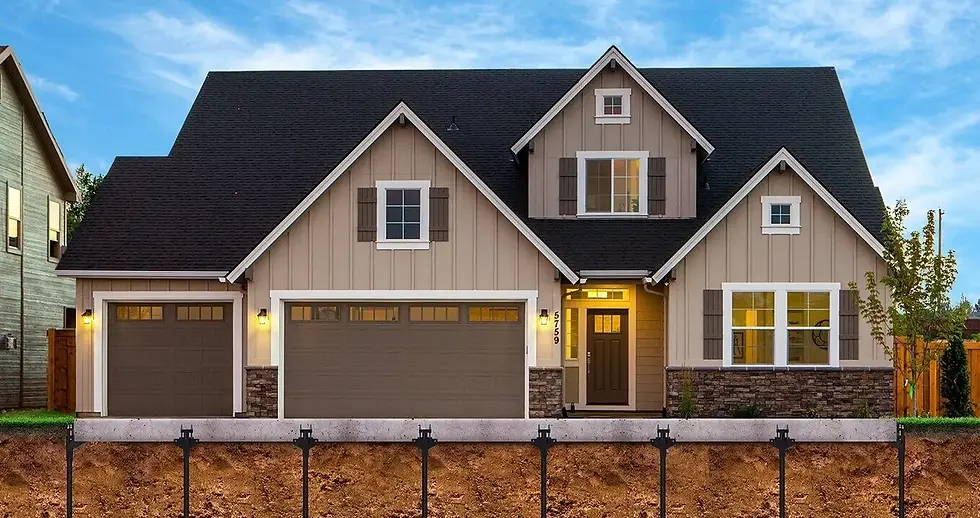
But that repair-only reputation sells the technology short. A helical pier is, at its core, a deep foundation element: a steel shaft with helical plates that gets mechanically screwed into the ground until it reaches soil that can actually carry a load. Nothing about that requires a distressed building on top. In fact, some of the smartest pier installs never touch a failing foundation — they go in before the footers do.
When you install helical piers on new construction, you're transferring the structure's load past the questionable near-surface soil down to competent bearing strata. The building never depends on the bad soil at all. Settlement problems aren't fixed later; they're designed out from day one.
The Land Math Has Changed
This is where it gets interesting for developers. A parcel with a rough soil report typically sits on the market longer and sells for less — because most buyers see the geotech findings and walk. That discount reflects everyone else's inability to build there, not yours.
If helical piers can carry your structure to competent soil, a lot you would have passed on two years ago can pencil today. You're often buying at a price that assumes the land is unbuildable, then solving the problem for a known, fixed cost per pier. Compare that pier cost against the premium you'd pay for a "clean" lot — if you can even find one in your market — and the math frequently favors the compromised parcel.
There's a second layer to this: pier costs are predictable in a way that soil remediation often isn't. Over-excavating and replacing bad soil, surcharging a site and waiting for consolidation, or redesigning around a mat foundation all carry schedule risk and cost uncertainty. A helical pier layout is engineered up front, priced per pier, and installed in days.
What Piers Do to Your Schedule (Spoiler: Nothing Bad)
Builders who spec helical piers for the first time are usually braced for a schedule hit. Here's what actually happens on site.
There's no cure time. Unlike drilled concrete piers or caissons, helical piers are load-bearing the moment they're installed. Your foundation work proceeds the same day — no waiting on concrete to reach strength before the next trade shows up.
They install in almost any weather. A wet Ohio spring or a Pennsylvania freeze that would shut down excavation and concrete work doesn't stop a pier crew. When your schedule is already tight, that weather resilience matters more than any spec sheet.
Installation is verified in real time. Torque readings are recorded at every pier as it goes in, and torque correlates directly to load capacity. That means every pier under your building comes with documented, verified capacity — paperwork your engineer, your building department, and your lender will actually be glad to see. If a warranty question ever surfaces years down the road, that file is worth its weight.
And the equipment footprint is small. Pier rigs work in tight infill lots and close to existing structures where bringing in a drill rig or major excavation simply isn't practical.
The Engineering Behind It: Our Ram Jack Partnership
A deep foundation system is only as credible as the engineering behind it, and this is where we're deliberate about what we install.
Eco-Seal installs the Ram Jack® Helical Foundation System through our partnership with Ram Jack, one of the most established names in engineered foundation solutions in North America. The system carries ICC-ES Evaluation Report ESR-1854 — a current, independently reviewed evaluation covering Ram Jack's helical piles and brackets for both new construction and existing-structure applications. Your structural engineer or building official can look up ESR-1854 directly and find the load tables, steel specifications, and installation requirements in black and white.
That evaluation matters in practice, not just on paper. When you're putting a foundation design in front of a plan reviewer or a lender, "engineered system with a current ICC-ES report" is a very different conversation than an off-brand pier your engineer has to evaluate from scratch. And because Ram Jack systems must be installed by certified, trained installers, you're not just buying steel — you're getting an installation that follows the same engineering standards the evaluation report is built on, backed by Ram Jack's national engineering support.
When Should a Builder Be Thinking About Piers?
The honest answer: earlier than most do. The best time to evaluate helical piers is when you're evaluating the land itself — at due diligence, not after the geotech report torpedoes your foundation design in permitting.
Broadly, piers deserve a look any time the soil report raises flags about bearing capacity in the upper soil layers. That includes sites with uncontrolled or undocumented fill, expansive clays that swell and shrink with moisture, high water tables, sloped lots where cut-and-fill creates inconsistent bearing conditions, and former agricultural or wooded land with organic layers that will decompose and settle. If your engineer is muttering about over-excavation, surcharge programs, or "geotechnical concerns" in a pre-bid meeting, that's your cue.
The earlier we see the soil report, the more useful we can be — sometimes that means confirming piers make the parcel work, and sometimes it means telling you they don't. We'd rather lose an install than put our name on a foundation we don't believe in.
Have a Parcel You've Been on the Fence About?
If there's a lot in your pipeline that the soil report has you second-guessing — or one you passed on that's still sitting on the market — send us the geotech report. We'll give you a straight answer on whether a helical pier foundation makes the site buildable, what the layout would roughly look like, and what it means for your budget and schedule.
Eco-Seal Home Solutions serves builders, general contractors, and developers across northeast Ohio and western Pennsylvania from our locations in Millersburg, OH and New Castle, PA.

Comments